

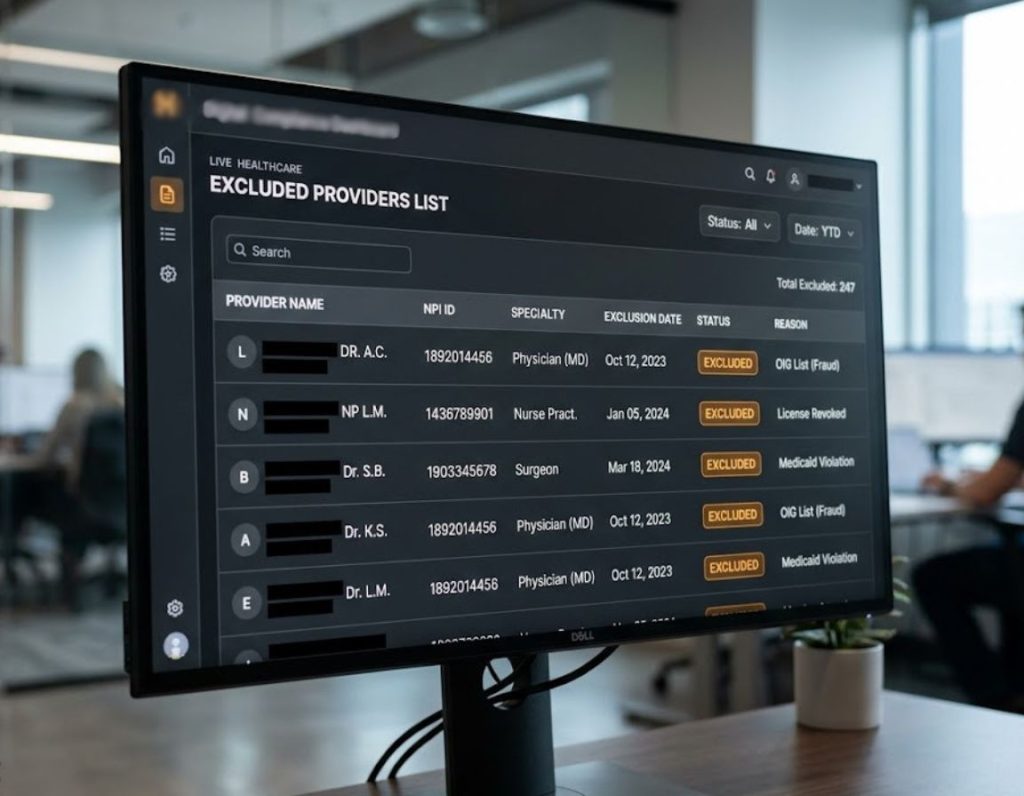
An excluded providers list is the set of federal and state databases that identify individuals and entities barred from participating in government healthcare programs. If you do not check the excluded providers list regularly, you expose your organization to repayment demands, civil monetary penalties, False Claims Act risk, and the kind of control failure that draws regulator attention fast.
What the Excluded Providers List Is
The excluded providers list usually means the HHS-OIG List of Excluded Individuals/Entities, or LEIE. Anyone on that list cannot receive federal healthcare program payment for items or services furnished, ordered, or prescribed. For compliance purposes, that is only the starting point. State Medicaid exclusion lists and related sanction sources also matter.
The federal list you must know
OIG has statutory authority to exclude individuals and entities from federally funded healthcare programs. The LEIE is the official federal database of current exclusions, and OIG makes it available through online search, downloadable files, and monthly supplements. That structure matters because your screening process must rely on current data, not a stale spreadsheet saved on someone’s desktop.
Exclusion is not limited to employed clinicians
Your risk does not stop with physicians, nurses, or direct employees. Contractors, temporary staff, vendors, billing personnel, ordering or referring professionals, and new enrollees all create exposure. If an excluded person touches federally reimbursable services in any meaningful way, your organization owns the compliance problem.
Why Regular Checks Are Essential for Compliance
Exclusion screening is not an administrative courtesy. It is a standing control tied directly to payment eligibility. The prohibition is strict, enforcement is active, and delayed detection increases liability with every claim cycle.
Monthly screening is the baseline standard
OIG states that the LEIE must be checked monthly and in connection with new enrollments. Annual checks fail basic compliance expectations. A one-time onboarding search fails for the same reason: exclusion status changes after hire, after contracting, and during ongoing credentialing relationships.
The financial and legal exposure is immediate
If you employ or pay an excluded person, the exposure starts immediately. OIG can impose civil monetary penalties exceeding $20,000 per item or service, require repayment of tainted claims, and trigger broader fraud review. Smaller organizations are not insulated. Recent enforcement examples include screening failure penalties of $35,000 and $41,000. That is what a “simple oversight” looks like on paper.
Screening failures create broader control failures
Missed exclusions do not stay isolated. During audits, investigations, payer enrollment reviews, or transactions, a failed screen signals weak credentialing, weak billing controls, and weak compliance oversight. That single gap can undermine confidence in your entire program.
What Makes Exclusion Screening More Complicated Than It Looks
A basic name check creates false confidence. Real screening requires verification, current data, and cross-list review.
False positives, name changes, and incomplete identifiers
Common names, former names, incomplete identifiers, and interstate moves make manual review unreliable. OIG does not distribute full Social Security numbers in download files, which is why it recommends using the online search to verify specific individuals.
State lists and related databases matter too
Federal LEIE screening alone is incomplete. State Medicaid exclusions, SAM.gov, and licensing board actions strengthen your controls because state action can appear before a federal update. If you screen only one list, you leave known gaps in your process.
Reinstatement must be verified
Exclusion does not end automatically. OIG states that reinstatement is not automatic, even after the exclusion period expires. Reengaging a person without formal reinstatement creates avoidable liability.
How You Should Structure an Effective Screening Process
Your process should be simple, repeatable, and documented.
Screen at onboarding, monthly, and after status changes
Screen before hire or contract execution, monthly afterward, and again after ownership, enrollment, role, or credentialing changes. New enrollments need separate review because enrollment itself is a known risk point.
Use automation and preserve an audit trail
Automation reduces human error and documents what was screened, when, and against which sources. If you maintain local LEIE data, use the full monthly database update, not just supplement files, because supplements are not the entire list.
Define your response when a match is found
Confirm identity first. If the match is real, stop billing, suspend the relationship, notify compliance and counsel, preserve records, and quantify claims exposure. Then assess disclosure obligations to OIG or state Medicaid authorities.
What Healthcare Leaders Should Take Away
Regular excluded provider screening is a legal control, not a clerical task. If you treat it that way, you protect reimbursement, reduce civil and criminal exposure, and show regulators that your compliance program is built to prevent avoidable violations.
This article is for informational purposes only and does not constitute legal advice. Accreditation requirements vary by state and payor contract. Consult with a qualified attorney regarding your specific compliance obligations.