

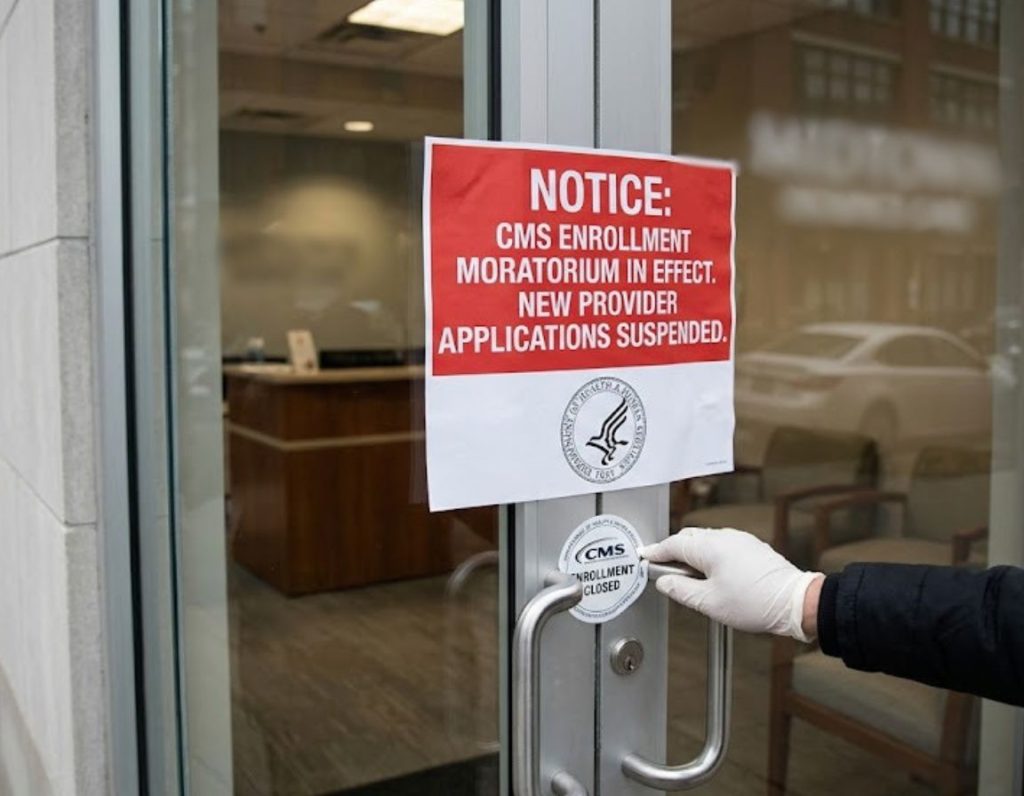
A CMS Enrollment Moratorium is a temporary federal pause on new Medicare participation for specific provider types, and for home health and hospice organizations, that pause changes deal timing, enrollment strategy, and compliance risk immediately. I have seen this kind of restriction matter most when a provider assumes a pending filing will simply move through the system, only to discover that CMS has turned enrollment into a denial exercise for the covered categories.
What the 2026 CMS Enrollment Moratorium Means
The 2026 CMS Enrollment Moratorium is a nationwide freeze on new Medicare enrollments for home health agencies and hospices that took effect on May 13, 2026 (CMS enrollment moratoria). In plain terms, CMS is not processing covered new entry applications as it ordinarily would. If a filing falls within the moratorium, CMS will deny it rather than let it sit for later approval.
The legal point that matters is scope. CMS tied the freeze to initial Medicare enrollments and to certain changes in majority ownership that are treated as new enrollments under the applicable regulations. That means a transaction that looks like a corporate change can still become an enrollment problem if it crosses the regulatory line into a new provider identity.
The moratorium started with an initial six-month term, and CMS has said it can extend the restriction in additional six-month increments if it decides the circumstances justify it (6 months). So I would not treat this as a short administrative pause and assume the market will normalize on a fixed date. It may, but the safer assumption is that CMS wants flexibility to keep the restriction in place longer.
Why CMS Imposed the Moratorium
CMS has framed the moratorium as a Medicare Program Integrity measure designed to curb fraud, waste, and abuse in sectors where it believes bad actors have exploited beneficiaries and taxpayers. That is not a casual justification. The agency is saying the enrollment gate itself has become part of the fraud problem, because once a fraudulent provider gets in, it can bill while investigators catch up.
CMS Administrator Dr. Mehmet Oz has described the problem as systemic and deeply troubling, and CMS has said the moratorium is meant to stop new bad actors from entering Medicare while the agency identifies, investigates, and removes providers already under suspicion (systemic fraud). CMS also says it will use advanced data analytics and targeted investigations to identify suspicious billing patterns, which tells me the enrollment freeze is only one part of a broader enforcement plan.
The headline numbers help explain the agency’s posture. CMS has said it already suspended payments to 773 hospices and 23 home health agencies in Los Angeles, involving roughly $70 million in allegedly fraudulent billing ($70 million). Whether one agrees with the breadth of the response or not, CMS is clearly treating home health and hospice as high-risk provider categories.
Which Providers Are Covered
The moratorium directly covers home health agencies and hospices. It is nationwide in effect, even though CMS’s enforcement rationale points to concentrated fraud concerns in certain states and markets. That distinction matters because a provider in a lower-scrutiny market can still be caught by a national rule.
It also matters that this is not a universal Medicare enrollment freeze. Other provider categories continue under their own enrollment rules, and CMS has been selective about where it uses this tool. The practical consequence is that home health and hospice leaders need to think about the moratorium as a targeted federal response, not a generalized Medicare policy shift.
Applications and Ownership Transactions Affected
The moratorium is not just about new licensees or brand-new businesses. It also reaches certain ownership transactions that CMS treats as new enrollments. That is where a lot of parties get caught, because a deal that seems like a standard purchase agreement can still trigger Medicare consequences.
Initial Medicare Enrollment Applications
Any initial Medicare enrollment application for a covered home health agency or hospice submitted after May 13, 2026 is subject to denial while the moratorium remains in effect (denied). Filing a complete application does not create an exception, and being “in process” does not preserve priority against the freeze. That is the hardest lesson for applicants who assume completeness equals entitlement.
For first-time entrants, the result is straightforward: if the application falls within the covered category and arrives after the implementation date, CMS is not treating it as a routine backlog item. It is a denied filing. In practical terms, that means market-entry timelines are now tied to federal program integrity policy, not just state licensure or accreditation readiness.
Home Health Change of Ownership (CHOW)
Home Health Change of Ownership, or CHOW, is where the moratorium becomes especially transactional. A CHOW does not always require a new enrollment, but certain ownership structures, especially non-exempt changes in majority ownership, can be treated as new enrollments under 42 CFR 424.550(b). If that happens during the freeze, the enrollment piece of the deal can fail even if the business assets, patients, and staff are ready to move.
I would treat this as a legal sequencing issue, not a clerical one. Sellers may believe they are simply transferring operations, while buyers are assuming Medicare participation will follow the assets. Under the moratorium, that assumption can be costly. A denied enrollment can disrupt revenue recognition, delay closing mechanics, and create contract default risk if the parties did not allocate the regulatory burden clearly.
Hospice Medicare Enrollment and Majority Ownership Changes
Hospice transactions deserve the same caution, and in some ways more. CMS’s hospice enrollment rules also treat certain changes in majority ownership as enrollment-sensitive events, which means a hospice deal can run into the moratorium even when the parties do not think of it as an “initial” entry into Medicare. Deal timing is therefore not a soft issue, it is often the deciding issue.
For investors, the key point is that a seemingly ordinary acquisition can be converted into a regulatory non-starter if the change is structured in a way CMS views as a new enrollment. That is why diligence on ownership, control, and effective dates needs to happen before signing, not after. Once the filing is made during the freeze, there is no practical room to argue for a better outcome just because the transaction is otherwise clean.
How the Moratorium Interacts with Medicare Program Integrity
The moratorium should be read as one part of CMS’s broader enforcement posture. CMS is not relying on enrollment restrictions alone. It is combining payment suspensions, site visits, data analytics, targeted investigations, and removal actions to push fraud controls upstream.
High-Risk Provider Category and Geographic Scrutiny
Home health and hospice are now operating as high-risk provider categories in CMS’s enforcement framework. That does not mean every provider is suspect. It means the agency believes the sector has enough documented abuse that a broad gatekeeping tool is justified. For compliant providers, the reality is frustrating, but it is also a clue about where scrutiny will focus.
Geography still matters. California, Arizona, Nevada, Texas, Georgia, and Ohio have repeatedly appeared in CMS-related scrutiny, and some markets have been placed under Provisional Period of Enhanced Oversight. Even though the moratorium is nationwide, the real-world pressure is not evenly distributed. Providers in those markets should expect more friction, more documentation demands, and less forgiveness for sloppy enrollment history.
Administrative Stay and Enhanced Oversight
The moratorium also sits alongside an administrative stay of sorts in the enrollment process, because CMS is intentionally pausing covered new entry while it intensifies oversight of the providers already in the system. That includes more aggressive use of site visits, claims review, and referral pattern analysis. In other words, the gate is closed, but the inside of the house is being searched more carefully.
For that reason, current providers should not read the moratorium as a safe harbor. It does not suspend revalidation duties, change reporting obligations, or survey expectations. It simply changes the posture of CMS toward new and newly structured participation.
OIG Fraud Investigation and DOJ Coordination
CMS has also rolled this out in coordination with broader federal enforcement efforts, including the Office of Inspector General and the Department of Justice. That matters because an enrollment issue can quickly become something bigger. Once billing data, ownership representations, and certification records are under review, the risk profile may extend beyond administrative denial into civil or criminal exposure.
I treat that as the real warning sign for owners and counsel. If CMS is already describing the market in fraud terms, then disclosure accuracy, billing integrity, and transaction documentation all need to be aligned. A bad enrollment decision can become a white collar defense problem faster than many providers expect.
Operational Consequences for Existing Providers
Existing enrollments are not automatically revoked by the moratorium, and current home health and hospice providers may continue operating. That is an important protection, because CMS is not shutting down the sector. It is restricting entry while it scrutinizes participation more closely.
What Current Enrolled Providers Can and Cannot Assume
Current participation does not guarantee future approvals for affiliates, successors, or transaction structures that CMS may treat as new enrollments. A parent company may still be enrolled, but a new entity formed for a deal can run into the freeze. The same is true for internal reorganizations that appear routine but change the Medicare identity enough to trigger enrollment treatment.
That distinction is why I would not rely on informal business assumptions here. The legal question is not whether the care will continue. It is whether the proposed structure creates a fresh enrollment event. If it does, the moratorium may stop it cold.
Telehealth and Face-to-Face Recertification
CMS has described a limited telehealth path for face-to-face recertification visits in this context, but providers should read that carefully and not generalize it beyond the rule. For hospices, CMS has also pointed to statutory and regulatory limits that can make telehealth face-to-face encounters noncompliant in moratorium or enhanced-oversight situations. That is a billing and certification issue, not a convenience option.
The safest approach is to verify how the temporary telehealth rule applies to the specific patient, provider location, and certification workflow before relying on it. Hospice and home health compliance teams should not assume that a telehealth visit that worked last year still works under the current framework.
Billing, Surveys, and Recertification Timing
Enrollment freezes do not remove ordinary compliance pressure. Survey readiness, documentation quality, and recertification timing still matter, especially for organizations nearing revalidation or operational expansion deadlines. If anything, the moratorium raises the stakes because CMS is already watching the sector more closely.
I would also expect the regulatory domino effect to continue. When federal enrollment scrutiny rises, state licensing boards and accrediting bodies often become more attentive as well. Providers should plan for that spillover, not just the federal action itself.
Strategic Risk Management for Providers and Investors
The practical response is disciplined diligence. Owners, CEOs, counsel, and private equity teams need to review filings and transaction structures before they become problems. Once a filing is submitted into a covered moratorium category, there is usually no easy correction path.
Deal Diligence Before Signing or Closing
Before signing or closing, I would review the exact enrollment status of the target, the ownership chain, the effective date of control transfer, and whether any part of the transaction could be treated as a new enrollment or non-exempt majority ownership change. That diligence should sit alongside licensure and payer review, not behind it. Medicare consequences can easily outlast the closing checklist if they are ignored.
Timing and Filing Discipline
Timing discipline matters because a filing submitted one day too late can be denied even if everything else is ready. The safer practice is to map the transaction timeline against the moratorium effective date and the applicable enrollment rules before any submission goes out. If the structure is close to the line, I would assume CMS will read it narrowly.
Documentation and Compliance Controls
The records that matter most are ownership charts, disclosure forms, billing audits, referral relationship files, survey history, and internal compliance reports. Those are the documents CMS and other regulators will use to test whether the organization has been accurate and consistent. For providers with more exposure, a pre-emptive file review is often the best way to reduce unpleasant surprises later.
Our firm has spent 50 years as a nationally recognized leader in this space, and that experience is most useful now, when a provider needs sober guidance rather than optimistic assumptions. Current enrollments are safe, but the accelerated removal phase means existing providers should schedule a Pre-emptive Compliance Review before the next filing, ownership change, or certification deadline. If the moratorium is the front door, the real risk is everything CMS is checking after you are already inside.
Market Impact and Policy Context
A nationwide freeze is broad as a legal matter, but its market impact is uneven. In high-scrutiny states, the policy will likely have real bite. In other markets, it may feel more symbolic, though that would be a mistake. Even a symbolic policy can change deal pricing, lender caution, and enforcement expectations.
Access to Care Concerns
Industry groups have argued that a blanket freeze can reduce access to legitimate care, especially in rural or underserved communities where provider supply is already thin. That concern is not theoretical. If a market already depends on limited hospice or home health capacity, new entry restrictions can mean longer wait times and fewer service options.
Why CMS Says the Impact Is Limited
CMS has said the moratorium should not materially affect a large number of small businesses, pointing to fewer than 400 new home health enrollments per year outside California and about 166 new hospice enrollments annually from 2023 through 2025, compared with roughly 11,500 enrolled HHAs and 7,000 enrolled hospices. On paper, that suggests the freeze is aimed at a narrow slice of the market. In practice, the providers most likely to feel it may be the ones trying to grow, acquire, or enter.
Why Competitor and Industry Commentary Matters
The industry’s preference for data-driven, risk-based enforcement is understandable. I agree with the underlying concern that a broad rule does not distinguish clean operators from fraudulent ones. Still, from a legal standpoint, that critique does not change what CMS can do today. Providers and investors should focus on the rule as written, then build compliance around it.
Practical Questions Providers Ask About the Moratorium
The same questions keep coming up, and for good reason. The rule affects business planning in ways that are easy to underestimate.
Does the Moratorium Apply Nationwide
Yes. Even though CMS’s justification is tied to concentrated fraud concerns in certain states and markets, the restriction itself is nationwide. A compliant provider outside a hotspot state is still subject to the same enrollment rule if its filing is covered.
Will Existing Medicare Participation Be Revoked
No, not by the moratorium alone. Existing enrolled providers are not automatically barred from continuing operations just because the freeze is in place. That said, CMS’s accelerated removal posture means current participation should not be treated as permanent insulation.
Can CMS Extend the Moratorium
Yes. CMS has said the freeze can be extended in six-month increments if the agency determines that is necessary. Providers should plan for a potentially longer restricted period, not just the initial six months.
Steps I Would Take Before Filing or Closing a Transaction
Before any filing or closing, I would confirm whether the action is an initial enrollment, a majority-ownership change, or another transaction CMS may treat as covered. I would then review the provider’s state and federal enforcement exposure, including any enhanced oversight, payment suspensions, or open investigations. Finally, I would align legal, compliance, and transaction teams so no one assumes a filing is routine when it is actually frozen.
Frequently Asked Questions
What is the CMS Enrollment Moratorium?
It is a temporary federal freeze on certain Medicare enrollment actions for covered provider types. For this policy, that means home health agencies and hospices cannot move forward with new enrollments that fall within the moratorium’s scope.
Does a pending application get grandfathered in?
No. A complete or pending filing does not avoid the moratorium if it was submitted after the effective date and falls within the covered category.
Does the moratorium stop current providers from operating?
No. Existing enrolled providers may continue furnishing services, but they should not assume future ownership changes or new entities will be approved.
How does the moratorium affect CHOW transactions?
A Home Health Change of Ownership can trigger enrollment consequences if it is treated as a new enrollment or a non-exempt majority ownership change. That makes deal structure and effective date timing especially important.
Can hospice providers still use telehealth for recertification?
CMS has described a limited telehealth path for face-to-face recertification visits, but hospice providers need to verify the current statutory and regulatory limits before relying on it.
Why should compliant providers still worry about this?
Because CMS is pairing the freeze with accelerated removal, targeted investigations, and data analytics. Even if your current enrollment is safe, your documentation, billing history, and transaction structure may still be scrutinized.
The immediate lesson is simple: do not treat the moratorium as background noise. For home health and hospice providers, it is now a live legal constraint on growth, acquisition, and enrollment strategy, and it deserves the same rigor as any other federal compliance risk.
This article is for informational purposes only and does not constitute legal advice. Accreditation requirements vary by state and payor contract. Consult with a qualified attorney regarding your specific compliance obligations.