

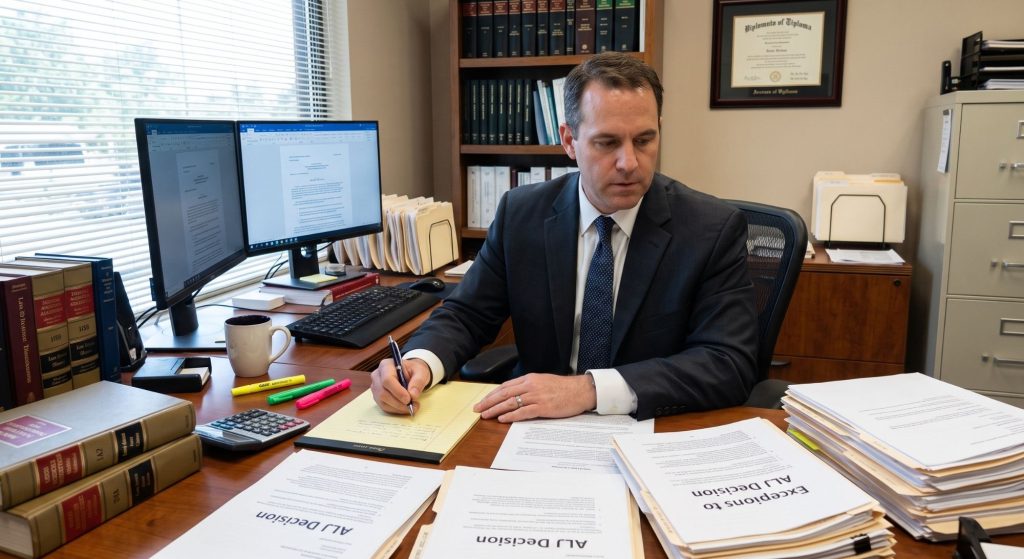
By Reynaldo T. Acosta, Esq., Head of Litigation, Vitale, Suarez & Associates, P.A. · Miami Lakes, Florida
Medicare Appeals Council review is not a second hearing. It is a written review of the ALJ’s decision, and the Council generally looks only at the points you tell it to look at. A point you do not raise is a point the Council is not required to reach.
If you run a practice, clinic, laboratory, or facility that lost at the ALJ level, you need to know four things before the 60 days run: what the request must say, which evidence the Council can still consider, how long the Council has to decide, and what happens to recoupment while the case is pending. Those four answers decide whether this level preserves your position or only spends your time.
In plain terms, Council review is the fourth level of the Medicare Part A and Part B appeal process in 42 C.F.R. Part 405, Subpart I. The article on the Medicare overpayment appeal process shows how the five levels fit together, and the article on the Medicare ALJ hearing covers the level that comes before it.
What the Council Does With Your Request
When a party asks the Council to review a decision by an ALJ or attorney adjudicator, the Council reviews the decision anew and does not defer to it. There is no right to a hearing before the Council, and the Council considers the administrative record. It may affirm the decision, change it, reverse it, or send the case back to an ALJ or attorney adjudicator for more proceedings (42 C.F.R. § 405.1108(a), § 405.1128).
That description sounds broad, and it is narrowed by the rule on exceptions. The Council generally limits its review to the exceptions the requester raises. An unrepresented beneficiary is exempt from that limit, and a provider is not (§ 405.1112(c)). In plain terms, the Council is not going to search a long decision for the point you meant to make. It is going to read the points you wrote down.
If the Council dismisses the request, it does so for reasons the rule lists: the request was late and no extension applies, the party withdrew it, or the party had no right to Council review (§ 405.1114). There is also no right to Council review of an ALJ’s or attorney adjudicator’s remand to a QIC, of an affirmance of a QIC’s dismissal of a reconsideration request, or of a dismissal of a request for review of a QIC dismissal (§ 405.1102(c)).
The 60-Day Request
A party to an ALJ or attorney adjudicator decision or dismissal can ask the Council for review by submitting a written request within 60 calendar days of receiving the decision or dismissal. Receipt is presumed five calendar days after the date on the notice, unless evidence shows otherwise. The request is treated as filed on the day the entity named in the ALJ’s or attorney adjudicator’s notice receives it (42 C.F.R. § 405.1102). By the time the request reaches the Council, most of the record has already been built below, and the rule limits what can still be added.
If the 60 days have passed, a party can ask for more time. The request must be in writing, must be filed with the Council, and must explain why the deadline was missed. The Council extends the period if it finds good cause, judged under the standards in § 405.942(b)(2) and (3) (§ 405.1102(b)). The article on good cause for a late Medicare appeal covers what those standards look like. The rule does not spell out any other consequence for a late request, and a late request with no extension is a ground for dismissal.
The practical point is the receipt date. A provider that counts from the date printed on the decision has a control that exists on paper only. Keep the envelope, the mail log, and the date you can prove, and calendar the 60 days from there. The article on Medicare appeal deadlines covers the full day count across the levels.
Where to File and Who Gets a Copy
The request goes to the entity named in the notice of the ALJ’s or attorney adjudicator’s action. The appellant must send a copy to every other party who received notice of that decision or dismissal. If a party is not copied, the Council’s adjudication period stays paused until all parties receive notice of the request. If the request is timely filed with a different entity, the Council’s period starts when the entity named in the notice receives it, and the Council notifies the appellant in writing of the receipt date (§ 405.1106(a)).
A request to escalate a case that an ALJ has not decided in time is filed with OMHA, with a copy to the parties who were sent the QIC reconsideration (§ 405.1106(b)). That route is discussed below.
What the Request Must Contain
The request must be in writing. The standard form is optional. A request that does not use the form is still accepted if it contains the beneficiary’s name and Medicare number, the services or items at issue, the dates of service, the date of the ALJ’s or attorney adjudicator’s decision or dismissal order, the name of the party or its representative, and any other information CMS specifies (§ 405.1112(a)).
The part that decides the case is the second requirement. The request must say which parts of the ALJ’s or attorney adjudicator’s action you disagree with and explain why. If you contend that the decision conflicts with a statute, a regulation, a CMS Ruling, or other authority, the request should explain the conflict (§ 405.1112(b)).
That is a drafting rule with a strategic consequence. A one-paragraph request that says only that the decision was wrong gives the Council nothing to review. A request that lists each exception, ties it to the part of the decision it attacks, and cites the authority gives the Council a defined set of questions. The text of the rule does not say what happens to a request that omits required content, so do not assume the Council will give you a second chance to supply it.
What the Council Can Consider
The Council generally reviews only the evidence already in the record before the ALJ or attorney adjudicator. If the ALJ’s decision resolves a new issue that the parties had no chance to address at the OMHA level, the Council considers evidence on that issue submitted with the review request. If the Council needs more evidence and the record shows earlier decision-makers never tried to get it, it may remand the case to an ALJ or attorney adjudicator (§ 405.1122(a)).
Late evidence faces a separate test. When a provider, a supplier, or a beneficiary they represent submits evidence to the Council for the first time on an issue the QIC already considered, the Council must decide whether good cause existed for not submitting it earlier. If good cause is lacking, the Council must exclude the evidence, cannot rely on it, and cannot remand the issue for consideration. The Council must notify all parties of any exclusion (§ 405.1122(c), see 42 C.F.R. § 405.1122).
In plain terms, the Council is the worst place to discover that a document is missing. The article on new evidence in a Medicare appeal explains why the record closes earlier than most providers expect, and the Council rule is the reason.
The Council can also issue subpoenas for documents when reasonably necessary, but cannot subpoena CMS or its contractors, and a subpoena issues only after a party has pursued discovery and a motion to compel (§ 405.1122(d)).
Briefs and Oral Argument
The Council gives the party seeking review and every other party a fair chance to submit written briefs or statements on the relevant facts and law when a party asks for it. The rule sets no fixed filing deadline. If you do not file your brief with the request, the time from when the Council receives the request until it receives your brief is not counted toward the Council’s processing time limit (§ 405.1120). Any party that files a brief must send a copy to every other party.
The Council may ask CMS or its contractor to file a brief or position paper, but cannot require it, and it does not treat a decision to stay out as evidence for or against either side.
A party may ask to appear before the Council for an oral presentation. The Council grants the request when the case presents a significant legal, policy, or factual issue that paper alone cannot adequately resolve, and it may also decide on its own that a hearing is needed (§ 405.1124). Treat oral argument as the exception, and write the brief as though it will be the only argument the Council hears.
The Council’s Decision Period
The Council has 90 calendar days from receiving the request to issue a final decision or dismissal, or to remand the case to the ALJ or attorney adjudicator. That period can be extended as provided elsewhere in the subpart (§ 405.1100(c)). The rule does not tell you how long a given file will wait in practice, so a cash plan that assumes the 90 days is built on the rule and not on the queue.
If you want the time to count, file the brief with the request. The rule says the clock stops for the days between the request and the brief when the brief comes later.
When the Case Arrives by Escalation
A case that an ALJ did not decide in time can be escalated to the Council by the appellant. For those cases the Council has 180 calendar days from receiving the escalation request (§ 405.1100(d)), and the period begins when the Council receives the request (§ 405.1106(b)).
In an escalated case, the Council may decide the case using the QIC-level record plus any additional evidence, including oral testimony, that the ALJ or attorney adjudicator admitted before escalation. It may also hold further proceedings, including a hearing, remand the case to OMHA, or dismiss the request if the appellant had no right to escalate (§ 405.1108(d)). If evidence submitted with the escalation request is material and no earlier decision-maker tried to obtain it, the Council may remand to an ALJ or attorney adjudicator to consider or obtain it (§ 405.1122(b)).
Escalation shortens the path and gives up the ALJ decision. The ALJ level is where testimony is taken, and an escalated case skips it. Weigh that against the cash plan before you choose.
Recoupment While the Request Is Pending
The pause on recoupment that applied during the redetermination and reconsideration does not reach this level. Under 42 C.F.R. § 405.379, an appeal to the ALJ, the Council, or federal court does not stop recovery, which remains in effect as provided in § 405.373(e). Recovery continues until the earliest of payment of the overpayment and interest in full, a satisfactory settlement agreement with the contractor, or a determination that no overpayment exists.
Plan the cash before you file. A provider that files a Council request and assumes the cash is protected has traded one delay for an offset. The article on a Medicare extended repayment schedule covers the one tool that may soften the cash impact.
How to Prepare a Council Request
Step 1: calendar the receipt date, the 60 days, and the recoupment dates together
Record the date you can prove you received the ALJ decision, the 60-day deadline, and the recoupment position. A request that is timely and a cash plan that is not protects you in only one direction.
Step 2: list the exceptions before you draft
Read the decision line by line and write each point you disagree with. Tie each one to the part of the decision it attacks and to the authority it conflicts with.
Step 3: separate what is in the record from what is not
Mark every exhibit that was before the ALJ. Anything that was not is subject to the good-cause test, and the Council cannot remand an excluded issue for consideration.
Step 4: draft the request to the rule
Include the beneficiary’s name and Medicare number, the services, the dates of service, the decision date, and the name of the party or representative, and explain each exception.
Step 5: decide whether to file the brief with the request
Filing the brief with the request avoids the time that would otherwise be excluded from the Council’s period. Filing later may let you respond to what you learn, at a cost to the clock.
Step 6: send copies and keep proof of filing
Send the request to the entity named in the notice, send a copy to every other party who received the decision, and keep proof of the date the Council’s intake received it.
Step 7: plan for the decision
The Council’s decision is the last administrative step. A party may bring an action in federal district court within 60 calendar days after receiving notice of it, and the article on a Medicare appeal in federal court covers that window.
Common Provider Mistakes at the Council Level
Writing a Request That Does Not Name the Exceptions
The Council generally limits its review to the exceptions you raise. A request that says the ALJ was wrong, without saying where, leaves the Council with nothing to decide.
Treating the Council as a Second Hearing
There is no right to a hearing before the Council, and oral argument is granted only for a significant issue that paper cannot resolve. A provider that plans to present its case in person may find that the written record is all the Council reads.
Submitting New Evidence Without a Good-Cause Reason
Evidence submitted for the first time on an issue the QIC considered must meet a good-cause test, and if it does not, it is excluded and cannot be the basis of a remand. The reason has to be documented, not asserted.
Forgetting to Copy the Other Parties
If a party is not copied, the Council’s adjudication period is paused until that party receives notice. A missed copy delays your own decision.
Assuming the Appeal Pauses Recoupment
It does not. The provider that files and assumes the cash is safe has traded a delay for an offset.
Making Informal Explanations That Become Admissions
A casual comment such as “we should have caught that at the hearing,” “the physician never signed that order,” or “we assumed the ALJ would see it our way” can later be cited as evidence of knowledge or systemic failure. Calls to the Council’s intake office, emails, and cover letters are part of the record. Your written request is part of the evidentiary record.
Troubleshooting: When the Request Does Not Go as Planned
If the Council dismisses the request as untimely, read the dismissal for the reason it states. If you had reasons for the delay that you did not present, the extension rule in § 405.1102(b) is a written request to the Council, filed with reasons, and it is not a request you can make informally by phone.
If the Council excludes evidence, read the notice. The Council must notify all parties of any exclusion, and the notice is the starting point for any argument that good cause existed.
If the Council remands the case, the decision returns to an ALJ or attorney adjudicator for further proceedings. The remand starts a new phase, so calendar the next dates and review whether recoupment is already running.
If the Council does not decide within its period, the appellant may ask that the appeal be escalated to federal district court, and the rules for that request are covered in the article on a Medicare appeal in federal court.
Expected Outcome: A Request the Council Can Act On
A well-prepared Council request produces a short, defined set of exceptions, a record in which every exhibit is marked as before the ALJ or not, a brief filed on a schedule you chose, and a cash plan that does not depend on the result. It does not guarantee a favorable decision. It does keep you from losing on a point you did not raise.
30-Day, 90-Day, and Ongoing Priorities
- Next 30 days. Confirm the receipt date and the 60-day deadline. List the exceptions. Mark the record. Draft the request and the brief.
- Next 90 days. Track the Council’s period. Prepare the federal court decision in case the Council affirms. Fund the recoupment calendar.
- Ongoing. Keep one owner for appeal dates. Review the amount-in-controversy figures each December if a federal court action is possible, because the threshold is updated annually.
When Counsel Should Be Involved
The Council level is where the quality of the written request matters most, because the exceptions you raise are the exceptions the Council generally reviews. If the ALJ decision turned on a statistical sample, if it turned on a coverage policy, if new evidence is part of the plan, or if recoupment is already running, legal review before the request is filed can shape the rest of the case. If counsel directs the review, communications about legal exposure may be better protected under the attorney-client privilege than informal email among billing and operations staff, where the privilege applies. These matters are described on the pages for Medicare and Medicaid overpayments and defense investigations, and the practice areas page lists the rest.
These rules are federal and apply wherever the demand originates.
The practical decision rule is simple: if you cannot list each exception in one sentence, if you cannot say which exhibits were before the ALJ, or if the recoupment calendar is not funded, the request is not ready. Draft the exceptions before you draft anything else.
Frequently Asked Questions
What is Medicare Appeals Council review?
It is the fourth level of the Medicare Part A and Part B appeal process. The Council reviews an ALJ or attorney adjudicator decision or dismissal, generally on the exceptions the requester raises (42 C.F.R. §§ 405.1108, 405.1112).
How long do you have to request Council review?
You have 60 calendar days from receiving the ALJ or attorney adjudicator decision or dismissal. Receipt is presumed five calendar days after the date on the notice unless evidence shows otherwise (42 C.F.R. § 405.1102).
What must the request say?
It must be in writing and include the beneficiary’s name and Medicare number, the services, the dates of service, the decision date, and the name of the party or representative. It must also specify which parts of the ALJ’s action you disagree with and explain why (42 C.F.R. § 405.1112).
Can you submit new evidence to the Council?
Generally the Council reviews the record before the ALJ. For evidence a provider submits for the first time on an issue the QIC already considered, the Council must find good cause for the delay, and if it does not, it must exclude the evidence (42 C.F.R. § 405.1122).
How long does the Council have to decide?
Ninety calendar days from receiving the request, or 180 days when the case is escalated from OMHA, subject to extensions provided in the subpart (42 C.F.R. § 405.1100). If you do not file your brief with the request, the days until the Council receives it are not counted.
Does Council review stop recoupment?
No. Recovery remains in effect as provided in 42 C.F.R. § 405.373(e) until payment in full with interest, a satisfactory settlement agreement, or a determination that no overpayment exists (§ 405.379).
What if the Council does not decide in time?
The appellant may ask that the appeal be escalated to federal district court, and the Council may still act within a short period after the request (42 C.F.R. § 405.1132). The option does not apply to appeals of an ALJ or attorney adjudicator dismissal.
About the author. Reynaldo T. Acosta heads the litigation practice at Vitale, Suarez & Associates, P.A. in Miami Lakes, Florida, the firm founded in 1982 as The Health Law Offices of Anthony C. Vitale, P.A. He is a member of The Florida Bar and earned his J.D. from Florida International University College of Law, where he was named to the Dean’s List and competed on the International Commercial Arbitration and the Negotiation and Mediation teams. He also holds a B.S. in Criminal Justice and Public Management with a minor in Political Science from Florida International University, and advanced certifications in generative artificial intelligence, machine learning, and agentic systems from IBM, Anthropic, and Microsoft. He is a member of the American Bar Association, the Hispanic National Bar Association, and the Cuban American Bar Association, and works with clients in English and Spanish. Learn more about the firm.
This article is for general information purposes only and should not be taken as legal advice for any individual case or situation. Reading it, or corresponding with us through this site, is not intended to create and does not create an attorney-client relationship. Federal and Florida healthcare regulations change frequently, and how any rule applies depends on the specific facts of your arrangement, your payor contracts, and your jurisdiction. Vitale, Suarez & Associates, P.A. is based in Miami Lakes, Florida and represents clients in Florida. If you have received an audit notice, records request, subpoena, civil investigative demand, or overpayment demand, speak with a licensed attorney before you respond.
Contact Our Healthcare Lawyers Today!
Schedule a Consultation: (305) 358-4500
Contact Us
Vitale, Suarez & Associates, P.A.
8100 Oak Ln Suite 403
Miami Lakes, FL 33016
Phone: (305) 358-4500
Fax: (305) 358-5113
Email: info@vitalehealthlaw.com
Hours: Monday through Friday, 9:00 a.m. to 5:00 p.m.
The firm’s attorneys work with clients in English and Spanish.