


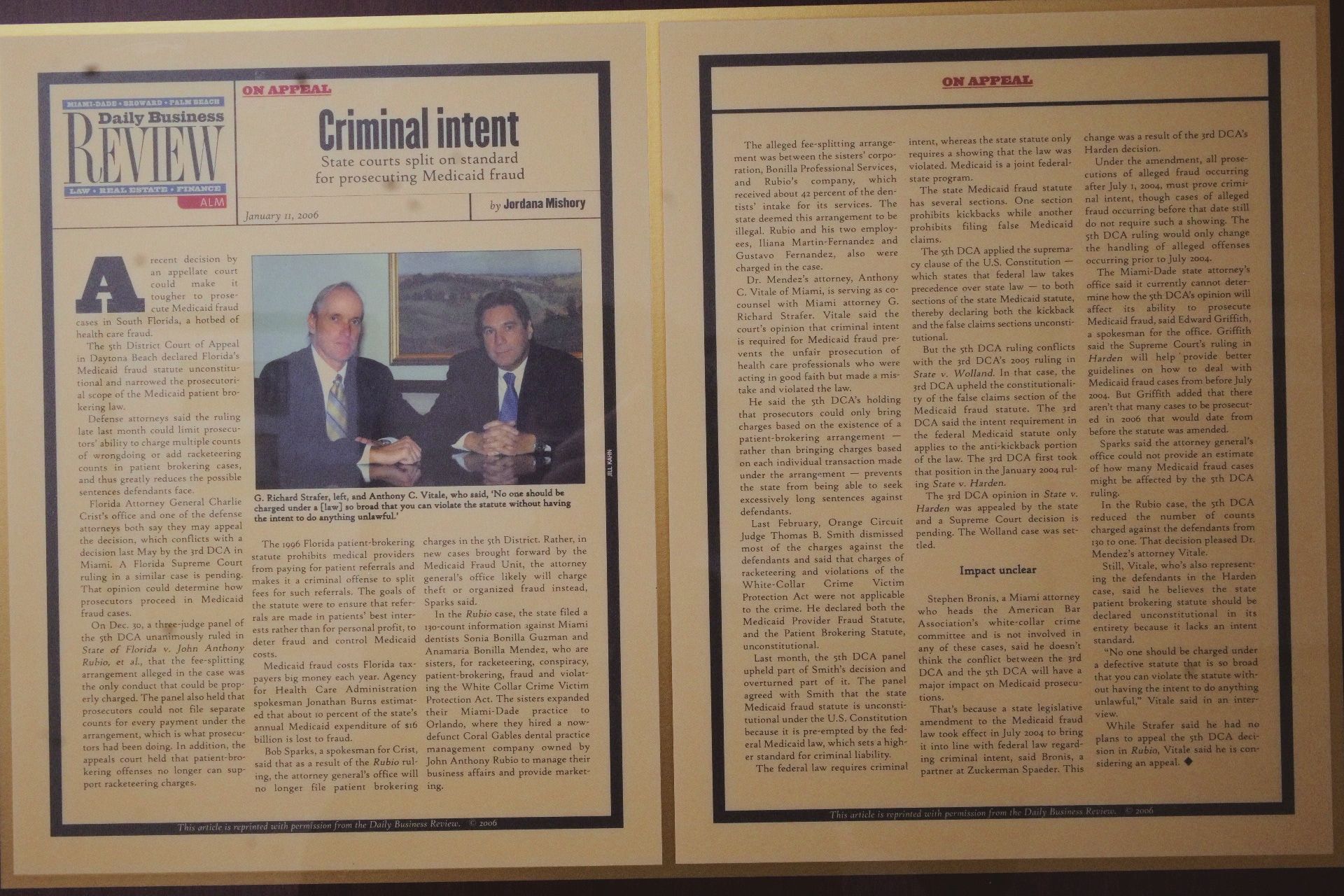
Nearly two decades ago, a single appellate ruling out of Daytona Beach set off a chain of events that would reshape how Florida prosecutors approach Medicaid fraud and patient brokering cases. A January 2006 article in the Daily Business Review — headlined “Criminal Intent: State Courts Split on Standard for Prosecuting Medicaid Fraud” — captured that pivotal moment in real time. Looking back, that coverage charts the legal crossroads that still defines Florida healthcare fraud defense today.
Key Takeaways
- Florida Statute 817.505 criminalizes kickbacks, bonuses, and split-fee arrangements for patient referrals.
- The Patient Brokering Act applies to all health care providers and facilities operating in Florida.
- A landmark 2005–2006 court split between Florida’s 3rd and 5th District Courts of Appeal forced a legislative fix that now requires proof of criminal intent for all post-July 2004 prosecutions.
- Prosecutors must establish criminal intent to secure a conviction under Section 817.505 of Florida Statutes.
What Does Criminal Intent Mean Under Florida Patient Brokering Law?
Florida patient brokering law, codified at Section 817.505 of the Florida Statutes, prohibits any person from offering, paying, soliciting, or receiving kickbacks, bonuses, or split-fee arrangements in exchange for patient referrals. The criminal intent standard that governs prosecutions today did not arrive fully formed — it was the product of hard-fought litigation, a district court split, and a legislative amendment that together reshaped the enforcement landscape.
The 2005–2006 District Court Split: A Look Back
In late 2005, the 5th District Court of Appeal in Daytona Beach issued its ruling in State of Florida v. John Anthony Rubio, et al., declaring Florida’s Medicaid fraud statute unconstitutional and narrowing the prosecutorial reach of the patient brokering law. The panel held that the federal Medicaid statute — which requires proof of criminal intent — pre-empted Florida’s then-existing state statute, which required only a showing that the law was violated.
That ruling directly conflicted with the 3rd District Court of Appeal’s earlier decisions in State v. Harden (January 2004) and State v. Wolland (May 2005), both of which had upheld the constitutionality of Florida’s Medicaid fraud statute. The 3rd DCA had reasoned that the federal intent requirement applied only to the anti-kickback portion of the law, not to the false claims section.
Anthony C. Vitale — then serving as co-counsel for one of the defendants in the Rubio case alongside Miami attorney G. Richard Strafer — was quoted in the Daily Business Review at the time: “No one should be charged under a defective statute that is so broad that you can violate the statute without having the intent to do anything unlawful.”
That principle is now embedded in Florida law.
How the Legislative Fix Changed Everything
The Daily Business Review article noted that a state legislative amendment had already taken effect in July 2004, bringing Florida’s Medicaid fraud statute in line with the federal criminal intent standard — a direct response to the 3rd DCA’s Harden decision. Under that amendment, all prosecutions for alleged fraud occurring after July 1, 2004, must prove criminal intent.
Looking back, that amendment resolved the constitutional tension the Rubio ruling exposed. Today, Florida Medicaid fraud criminal intent is a required element in every prosecution under the amended statute. Providers who document their compliance efforts and can demonstrate good-faith conduct have a meaningful basis on which to challenge intent-based allegations.
Can Providers Get Advance Guidance Before Entering a Referral Arrangement?
Florida law expressly permits providers to seek a declaratory judgment or an advisory opinion from state regulators before entering arrangements that could trigger liability under the Florida anti-kickback statute. This proactive step helps establish good-faith intent — precisely the kind of documented conduct that courts have recognized as relevant to the criminal intent inquiry. The Health Law Offices of Anthony C. Vitale, P.A., a Miami Lakes, FL-based firm, serves Florida providers navigating these compliance decisions and offers a free 15-minute consultation to assess risk.

How Does Florida’s Anti-Kickback Framework Intersect With Medicaid Fraud?
Florida’s anti-kickback statute framework directly links to Medicaid fraud statute Florida enforcement because the Florida patient brokering law incorporates the federal Anti-Kickback Statute (AKS) by reference. The Rubio ruling underscored that point: the 5th DCA applied the Supremacy Clause to both the kickback and false claims sections of the state statute, finding both pre-empted by the federal standard. Conduct that violates the federal AKS simultaneously triggers state-level exposure, meaning a single arrangement can generate both federal and Florida criminal liability.
What Conduct Does Florida’s Patient Brokering Act Prohibit?
The statute bars any commission, bonus, rebate, or split-fee arrangement paid to induce patient referrals. The Rubio case itself centered on a fee-splitting arrangement between a dental practice and a practice management company — an arrangement the state alleged was illegal precisely because the management company received approximately 42 percent of the dentists’ intake in exchange for its services. The 5th DCA’s ruling in that case reduced the charged counts from 130 to one, reinforcing the principle that a single arrangement, not every individual transaction under it, is the proper unit of prosecution.
The statute’s exception mirrors federal safe harbor language, exempting only payment practices not prohibited under 42 U.S.C. § 1320a-7b(b). Providers who fall outside those safe harbors face exposure on both tracks simultaneously.
Who Enforces These Laws in Florida?
Florida healthcare fraud prosecution draws on multiple enforcement agencies — including the DOJ, OIG, FBI, and CMS — all of which coordinate on Florida cases. As the Daily Business Review reported in 2006, South Florida was already a recognized hotbed of healthcare fraud, with the Agency for Health Care Administration estimating that roughly 10 percent of the state’s then-$16 billion annual Medicaid expenditure was being lost to fraud. That enforcement priority has only intensified in the years since, particularly in the drug treatment industry.
Medicaid fraud Florida penalties can include criminal charges, exclusion from federal programs, and civil monetary penalties. Healthcare providers navigating these overlapping frameworks benefit from counsel experienced in both federal and state anti-kickback law.
What Should Florida Providers Do When Facing Medicaid Fraud Charges?
Florida providers facing Medicaid fraud charges must retain specialized legal counsel immediately. The Rubio case is a vivid reminder of how quickly an investigation can snowball — a 130-count information covering racketeering, conspiracy, patient brokering, fraud, and White Collar Crime Victim Protection Act violations — before courts step in to recalibrate prosecutorial overreach. Delayed action allows investigators to build cases that become significantly harder to defend.
Florida healthcare fraud prosecution targets a defined set of schemes, including:
- Billing for services never rendered
- Ordering unnecessary treatments
- Falsifying claims or medical records
- Misrepresenting the nature of services provided
- Overcharging Medicaid for covered care
Each scheme carries serious Medicaid fraud Florida penalties, including criminal liability, exclusion from federal programs, and civil monetary damages.
What Role Does Criminal Intent Play in Florida Medicaid Fraud Cases?
Florida Medicaid fraud criminal intent is a central element prosecutors must establish in every post-July 2004 case. The 2004 legislative amendment that resolved the district court split enshrined this standard in Florida law. Providers who document compliance efforts and maintain accurate records create a factual record that directly challenges intent-based allegations — the same principle Vitale argued before the courts in 2005 and 2006.
How Does Florida’s Patient Brokering Law Affect Fraud Exposure?
The Florida patient brokering law — codified under Section 817.505 of the Florida Statutes — prohibits kickbacks, referral fees, and split-fee arrangements between providers. The Florida anti-kickback statute mirrors federal prohibitions and remains an active enforcement priority across the state. Florida patient brokering criminal defense requires counsel experienced in both state and federal frameworks — and, as the history of Rubio, Harden, and Wolland makes clear, familiarity with the evolving case law that continues to shape how those laws are applied.
The Health Law Offices of Anthony C. Vitale, P.A., based in Miami Lakes, FL, represents Florida providers in Medicaid Fraud Control Unit investigations, False Claims Act matters, and anti-kickback disputes — and offers a free 15-minute consultation to assess next steps.
FAQ
What was the significance of the 2006 State v. Rubio ruling?
The 5th District Court of Appeal’s decision in State v. Rubio declared Florida’s then-existing Medicaid fraud statute unconstitutional, finding it pre-empted by federal law’s higher criminal intent standard. The ruling conflicted with the 3rd DCA’s decisions in State v. Harden and State v. Wolland, and it reinforced pressure for the legislative amendment — already enacted in July 2004 — that brought Florida’s statute in line with the federal requirement.
Does Florida’s patient brokering statute require proof of specific criminal intent?
Yes — for all prosecutions involving conduct occurring after July 1, 2004. A legislative amendment enacted in response to the 3rd DCA’s Harden decision aligned Florida’s Medicaid fraud statute with the federal criminal intent standard. The district court split documented in the 2006 Daily Business Review article accelerated judicial and legislative clarity on this point.
How do providers seek advance guidance before entering a referral arrangement?
Florida law expressly permits providers to seek a declaratory judgment or an advisory opinion from state regulators, a proactive step that establishes good-faith intent and addresses anti-kickback statute exposure before any arrangement is entered.
What does Florida’s Patient Brokering Act prohibit?
Section 817.505 criminalizes offering, paying, soliciting, or receiving kickbacks, bonuses, rebates, or split-fee arrangements to induce patient referrals among all health care providers and facilities operating in Florida. The statute’s exceptions mirror federal safe harbor language under 42 U.S.C. § 1320a-7b(b).