

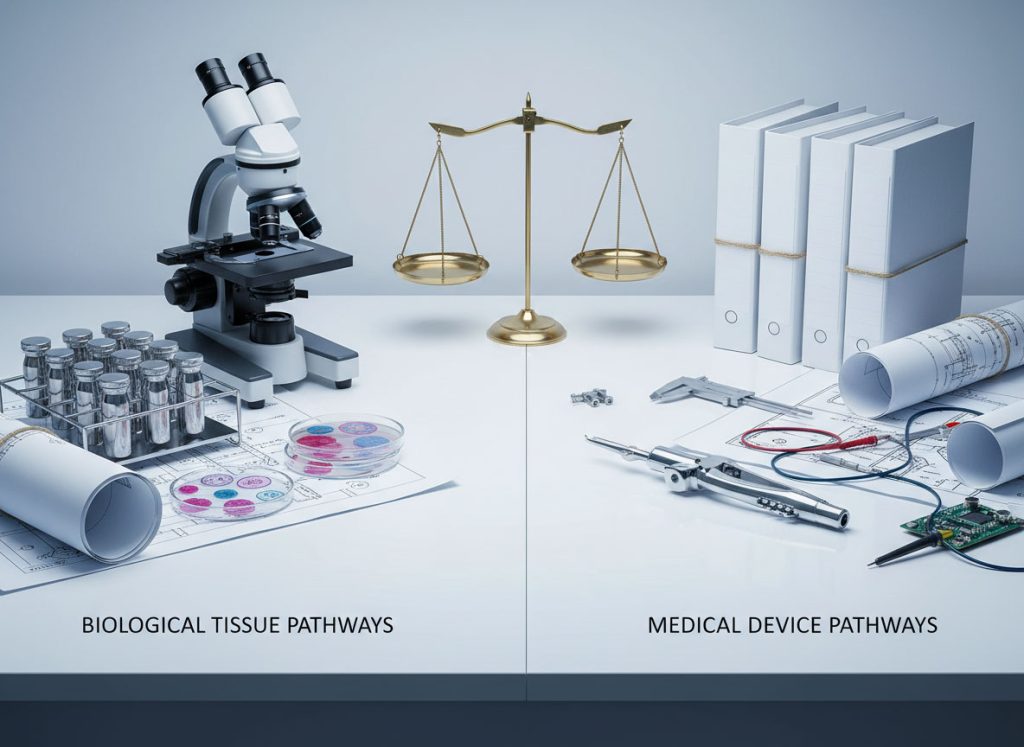
Why FDA regulatory pathway compliance matters in wound care
If you rely on skin substitutes and biologics to keep chronic wound patients out of the OR, you already feel the pressure. RACs, UPICs, and whistleblowers have learned to chase margins in wound care products. When auditors descend, they look first at medical necessity and documentation. Increasingly, they also ask a quieter question: was the product used under the correct FDA regulatory pathway.
Understanding FDA regulatory pathway compliance (361 HCT/P vs 510k) will not replace clean charts or proper coding. It will, however, determine whether you are defending a standard utilization review or an allegation that you billed a product in a way that the FDA never approved. That is a very different conversation with CMS, commercial payers, or the Department of Justice.
The Health Law Offices of Anthony C. Vitale P.A. helps wound care providers navigate this gray zone before it becomes a crisis. You do not need to become a regulatory scientist, but you do need a working playbook.
The two key FDA pathways you must understand
In wound care, the most common confusion arises between three overlapping categories:
- Section 361 HCT/Ps
- Section 351 HCT/Ps
- Medical devices cleared through 510(k) or approved through PMA
Your risk exposure often turns on whether a product truly fits the 361 HCT/P framework, or whether it should be treated as a drug, biologic, or device that requires premarket review.
Section 361 HCT/Ps: Lower risk, no premarket review
In the 1990s, the FDA created Section 361 of the Public Health Service Act to regulate human cells, tissues, and cellular and tissue based products that do not pose a significant risk to public health. These 361 HCT/Ps can be marketed without an Investigational New Drug (IND) application or premarket approval if they meet all requirements in 21 CFR 1271.10(a).
To qualify as a 361 HCT/P, a product must:
- Be minimally manipulated
- Be intended for homologous use only
- Not rely on the metabolic activity of living cells for its primary function, or if it does, meet specific criteria regarding systemic effects
- Be manufactured without adding disqualifying agents or components
- Be produced by an establishment that registers and lists its HCT/Ps with the FDA under 21 CFR part 1271
When all five are met, the product is regulated solely under Section 361. There is no FDA premarket approval or prior FDA review of clinical investigation, and oversight of studies is typically through Institutional Review Boards (IRBs).
Tissue allografts, including certain Wharton’s Jelly products, can fall into this category when they function as tissue allografts rather than cellular therapies and when they satisfy the minimal manipulation and homologous use standards.
Section 351 and 510(k) or PMA devices: Higher scrutiny, higher stakes
If any of the 21 CFR 1271.10(a) criteria are not met, the product is regulated as a drug, device, or biological product under Section 351 of the PHS Act and the Food, Drug, and Cosmetic Act. This is where many wound care providers get caught.
For products that are devices, FDA pathways typically include:
- 510(k) premarket notification, where the FDA evaluates whether a device is substantially equivalent to a legally marketed predicate device. That review can involve scientific, nonclinical, and clinical data as needed.
- Premarket Approval (PMA), which is the most stringent pathway, reserved for high risk devices that are life supporting, life sustaining, or that present potential unreasonable risks. PMA requires independent demonstration of safety and effectiveness.
The FDA’s Medical Device Amendments of 1976 established a risk based framework. Higher risk devices face more rigorous scrutiny. Since 2012, the FDA has reclassified hundreds of devices from 510(k) eligibility into Class III status that requires PMA when new safety information justified tighter control. Despite increasing complexity of 510(k) cleared devices, FDA data as of September 2023 show that under 2 percent of such devices face Class I or II recalls annually, which signals a generally low risk profile for products cleared through this pathway.
When you use a device based skin substitute or advanced dressing, you are usually in the 510(k) universe. Your billing, marketing, and clinical use must align with the specific indications, contraindications, and instructions for use in that 510(k) clearance.
Minimal manipulation and homologous use in plain language
Two concepts drive whether a product can live in the 361 space or must move into the 351 / device world: minimal manipulation and homologous use. Those phrases appear in federal regulations, but you need them in operational terms.
Minimal manipulation
Minimal manipulation asks whether processing has altered the original relevant characteristics of the tissue relating to its utility for reconstruction, repair, or replacement.
Processing adipose tissue into stromal vascular fraction, for example, through enzymatic or mechanical isolation of cells, is considered more than minimal manipulation. Products like SVF, therefore, cannot be treated as 361 HCT/Ps. They require FDA review before marketing or clinical investigation.
For you, that means:
- Do not assume that “tissue based” equals 361.
- Look closely at how the product is processed and marketed. Heavy processing, concentration of cells, or significant alteration of structure usually push the product into 351 or device territory.
Homologous use
Homologous use means the product performs the same basic function in the recipient as in the donor.
If adipose tissue is used for cushioning and support in the donor, then using it for cushioning and support in the recipient can be homologous. Using that same tissue for breast augmentation or cartilage regeneration is not. Those non homologous uses require FDA review and move the product outside the 361 pathway.
In wound care, this matters when you are:
- Using a product for a novel indication that goes beyond its labeled or intended function
- Participating in a clinical study where the tissue is being used in a way that is not clearly homologous
If a study or clinical use is outside the homologous use framework, FDA review is required. That can change how your payers view medical necessity and coverage.
361 HCT/P registration vs approval: What auditors look for
Many vendors and even some providers mistakenly treat Section 361 registration as a form of approval. It is not.
Establishments that manufacture 361 HCT/Ps must:
- Register and list their products with FDA under 21 CFR part 1271 within five days of beginning operation
- Update their registrations annually in December
- Use the FDA’s electronic Human Cell and Tissue Establishment Registration System (eHCTERS) unless granted a waiver
Establishments producing HCT/Ps that are drugs, devices, or biological products under Section 351 must register and list under 21 CFR parts 207 or 807 instead. That includes products cleared through 510(k).
The FDA is explicit that acceptance of an HCT/P registration and listing does not imply compliance with regulations and does not mean the product is licensed or approved. Registration is an administrative requirement, not a quality seal.
When a payer or enforcement agency reviews your wound care program, they may ask:
- Is this product marketed as a 361 HCT/P, and if so, does it realistically meet all 1271.10(a) criteria
- Is there any FDA clearance or approval, such as a 510(k), for the exact indication and route of administration you are billing
- Has the vendor’s marketing strayed into claims that exceed its FDA status
If the answers are unclear, your claims can be characterized as misbranded or non covered, and any overpayments can quickly grow.
Device vs tissue in clinical investigations and comparisons
Some wound care providers are involved in clinical investigations that compare 361 HCT/P products to 510(k) cleared medical devices. In this setting, regulatory classification of both the investigational product and the comparator device matters.
For a device comparator:
- Use must be consistent with its labeling, or
- The device must qualify as a non significant risk device with an abbreviated IDE path
If you use a 510(k) device off label in a way that triggers significant risk, you may unintentionally invoke additional regulatory pathways and obligations far beyond the 361 HCT/P framework.
For the 361 product:
- It must truly meet the minimal manipulation and homologous use requirements
- The study should be overseen by an IRB and structured to remain within the 361 scope, or otherwise proceed under an IND or IDE
If you are not sure where your study sits, you should not rely solely on the sponsor’s interpretation. You need independent legal and regulatory input.
How misalignment drives audits and whistleblower risk
Misalignment between FDA regulatory pathway compliance (361 HCT/P vs 510k) and your billing practices is fertile ground for:
- Medicare and Medicaid post payment audits
- Commercial payer recoupment efforts
- Whistleblower claims alleging off label promotion, misbranding, or medically unnecessary use
In the wound care space, we see patterns such as:
- Clinics using a tissue product marketed as 361 in ways that look more like a drug or device therapy
- Heavy reliance on vendor training that glosses over limitations in FDA status
- Documentation that parrots marketing claims rather than the product’s actual clearance or intended use
If an internal or external whistleblower targets skin substitute utilization, your FDA regulatory position becomes an evidentiary issue. You may already be dealing with whistleblower claims for skin substitute overutilization or facing a focused review of product wastage that calls your utilization patterns into question. In those cases, you want to show that you understood the product’s pathway and did not stretch it beyond what the FDA allows.
Practical steps to tighten your wound care compliance
You can reduce risk without shutting down appropriate advanced therapies. The key is to operationalize FDA awareness in your wound program.
Build a product level regulatory file
For every skin substitute or biologic you use, maintain a concise but complete file that includes:
- Whether the product is a 361 HCT/P, a 351 product, or a device
- For devices, the 510(k) number and a copy of the FDA summary, including indications and contraindications
- For 361 HCT/Ps, documentation showing that the product is marketed under 21 CFR part 1271 and that the manufacturer is registered
- Vendor training materials, carefully annotated with any limitations or clarifications based on the actual FDA status
This file becomes your starting point when an auditor questions coverage or medical necessity.
Align policies, consents, and orders with the pathway
Once you know the regulatory status:
- Ensure your clinical policies and standing orders mirror the product’s FDA pathway and labeled indications
- Revise informed consent forms and patient education materials that currently overstate benefits or imply approvals that do not exist
- Train clinicians to document based on clinical indications and FDA status, not vendor language
When you defend claims, surveyors and auditors will look for consistency between policy, documentation, and product status.
Integrate FDA checks into reimbursement defense
If you are already under a Medicare or Medicaid review for skin substitutes, build FDA pathway questions into your defense strategy:
- Does the alleged overutilization intersect with uses not supported by the product’s FDA pathway
- Are questioned claims concentrated around a specific product that has ambiguous regulatory status or aggressive marketing
- Did wastage patterns relate to package sizes or application frequencies that do not align with labeling
Our firm routinely combines medical necessity analysis with FDA pathway review in cases involving medicare skin substitute wastage audit lawyer services. You should not treat these issues as separate problems. They are often two sides of the same enforcement coin.
When to bring in The Health Law Offices of Anthony C. Vitale P.A.
You do not need a law firm to read a product brochure. You do need experienced counsel when:
- You receive a payer audit or extrapolation that focuses heavily on one or two advanced wound products
- You discover that a widely used product in your clinic is being challenged nationally on its regulatory status
- You are asked to participate in a clinical trial or vendor driven “protocol” that seems to push beyond labeled use
- A whistleblower complaint or internal concern raises questions about product promotion, wastage, or overutilization
The Health Law Offices of Anthony C. Vitale P.A. works with wound care clinics, hospital based programs, and physician offices nationwide on these issues. We map the FDA pathway, tie it to your payer contracts and coverage criteria, and then design a clear remediation or defense strategy that surveyors and auditors can follow.
Key takeaways
- FDA regulatory pathway compliance (361 HCT/P vs 510k) is no longer an abstract manufacturer issue. It is central to how auditors and whistleblowers evaluate your wound care program.
- Section 361 HCT/P status requires strict minimal manipulation and homologous use. If those elements fail, you are in the drug, biologic, or device world and premarket review is required.
- 510(k) clearance and PMA approval carry specific indications and labeling. Off label use and vendor driven “shortcuts” can turn a routine audit into an enforcement action.
- Registration of a 361 HCT/P does not equal FDA approval. You should never treat it as a compliance shield in your documentation or marketing.
- A structured regulatory file for each product and alignment of policies, consents, and orders with the true FDA pathway are critical tools in wound care reimbursement defense.
FAQs
1. Why should I care about 361 HCT/P vs 510(k) if payers are already reimbursing the product?
Payers may reimburse based on codes and coverage policies that assume proper FDA status. If an audit later shows the product was misclassified or used outside its pathway, prior payment does not protect you. You can face recoupments, extrapolated damages, and potential False Claims Act exposure.
2. How do I confirm whether a product is cleared through 510(k) or marketed as a 361 HCT/P?
Start with the manufacturer’s FDA documentation. For devices, obtain the 510(k) number and FDA summary. For HCT/Ps, confirm registration and listing under 21 CFR part 1271. Remember that FDA acceptance of a registration does not mean the product is approved. If the documentation is incomplete or inconsistent, involve regulatory counsel.
3. Can I rely on vendor training to stay compliant with FDA requirements?
Vendor training can be useful, but it is inherently promotional. You are responsible for ensuring that your clinical use and documentation align with the actual FDA status and labeled indications, not with marketing claims. Where there is any ambiguity, you should obtain independent legal and regulatory advice.
4. How does FDA pathway compliance affect a Medicare skin substitute wastage audit?
In a wastage audit, reviewers look at dosing, frequency, and package sizes relative to clinical need and labeling. If your use pattern conflicts with the product’s 510(k) or with reasonable assumptions for a 361 HCT/P, auditors may treat wastage as unnecessary or noncovered. Aligning utilization and documentation with the correct pathway strengthens your defense.
5. When should I contact The Health Law Offices of Anthony C. Vitale P.A. about my wound care program?
You should reach out if you receive an audit notice, suspect overutilization or wastage issues, are approached with an aggressive product or protocol by a vendor, or simply want a proactive review of your skin substitute and biologic usage. A focused regulatory and reimbursement assessment can help you correct course before a payer or whistleblower forces the issue.
This article is for informational purposes only and does not constitute legal advice. Accreditation requirements vary by state and payor contract. Consult with a qualified attorney regarding your specific compliance obligations.